Travel
Location:Home>Travel to Shanghai
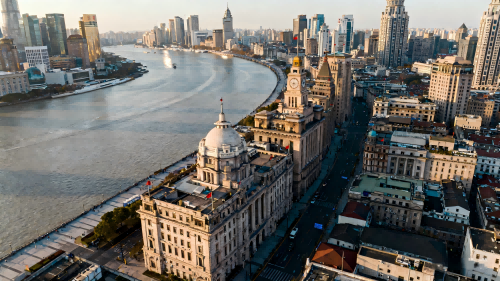 Shanghai is situated at 31° 14' North Latitude and 121° 29' East Longitude, on the west shore of the Pacific Ocean. Located at the mouth of the Yangtze River, it borders Jiangsu and Zhejiang provinces to the west and forms the Yangtze River Delta together with neighboring Zhejiang, Jiangsu and Anhui provinces. As one of China’s most economically dynamic, open and innovative regions, Shanghai had an administrative area of 6,340.5 square kilometers by the end of 2023, comprising 16 districts, with a permanent population of 24.8745 million and a per capita GDP of 190,300 yuan.
Shanghai’s terrain features an average altitude of 2.19 meters, with Dajinshan Island as its highest point (103.7 meters). Its river network is dominated by the Huangpu River (the main urban waterway) and its tributaries, including the Suzhou River, Chuanyang River and Dianpu River. Dianshan Lake is the city’s largest lake, and there are three major islands: Chongming (China’s third-largest island), Changxing and Hengsha.
· Shanghai Weather & Climate
Shanghai has a pleasant north subtropical maritime monsoon climate, with four distinct seasons, abundant sunshine and rainfall. Spring and autumn are relatively shorter than summer and winter. The average annual temperature is 18°C, with a frost-free period of up to 230 days and average annual rainfall of 1,200 millimeters (about 50 inches) – nearly 60% of which falls between May and September (the flood season), divided into three rainy periods: Spring Rains, Plum Rains and Autumn Rains.
The hottest months are July and August, when temperatures can reach 35°C for around 10 days. The coldest period is from late January to early February (usually during the Chinese Spring Festival), with extreme cold lasting about three days and rare snowfall. The best travel season is March to May, with mild weather. The Plum Rain Season runs from mid-June to early July, and typhoons may occur from late August to the first 20 days of September (though recent typhoons have caused little damage).
Recommended clothing: Light coats and sweaters for spring; short-sleeved shirts for summer; long-sleeved shirts, sweaters and coats for autumn; and sweaters and overcoats for winter.


· Currency
Local Currency
China’s legal tender is Renminbi (RMB), issued by the People’s Bank of China. The basic units are Yuan, Jiao and Fen, with the conversion: 1 Yuan = 10 Jiao = 100 Fen. Colloquially, Yuan is often called “Kuai” and Jiao “Mao.” RMB is available in both notes and coins:
Notes: 100, 50, 20, 10, 5, 2, 1 Yuan; 5, 2, 1 Jiao; 5, 2, 1 Fen
Coins: 1 Yuan; 5, 2, 1 Jiao; 5, 2, 1 Fen
Credit cards are accepted at most hotels, tourist shops and some department stores.
Currency Conversion
Foreign currency can be exchanged at Shanghai’s international airports, most hotels and Bank of China branches. The exchange rate is uniform across all outlets on the same day. Banking Hours: Mondays to Fridays, 9 a.m. to 5 p.m.
Foreign Exchange
No quantitative restrictions on foreign currencies, traveler's cheques or credit cards brought into China.
Inbound passengers carrying more than 5,000 US dollars in cash must declare it to Customs. The declared amount will be allowed for departure upon verification.
If the cash amount exceeds the previously declared amount (or no prior declaration was made), the excess can be released with a certificate from the State Administration of Foreign Exchange (SAFE) or its authorized banks.
The limit for RMB brought into or taken out of China is 20,000 yuan.
· Voltage
Electricity is supplied at 220 volts (50 hertz).